



How Virtual Queue Management Is Changing the Way Customers Experience Your Business: Powerful Reasons in 2026
May 12, 2026
The New Winning Standard of Business Operations 2026
May 14, 2026
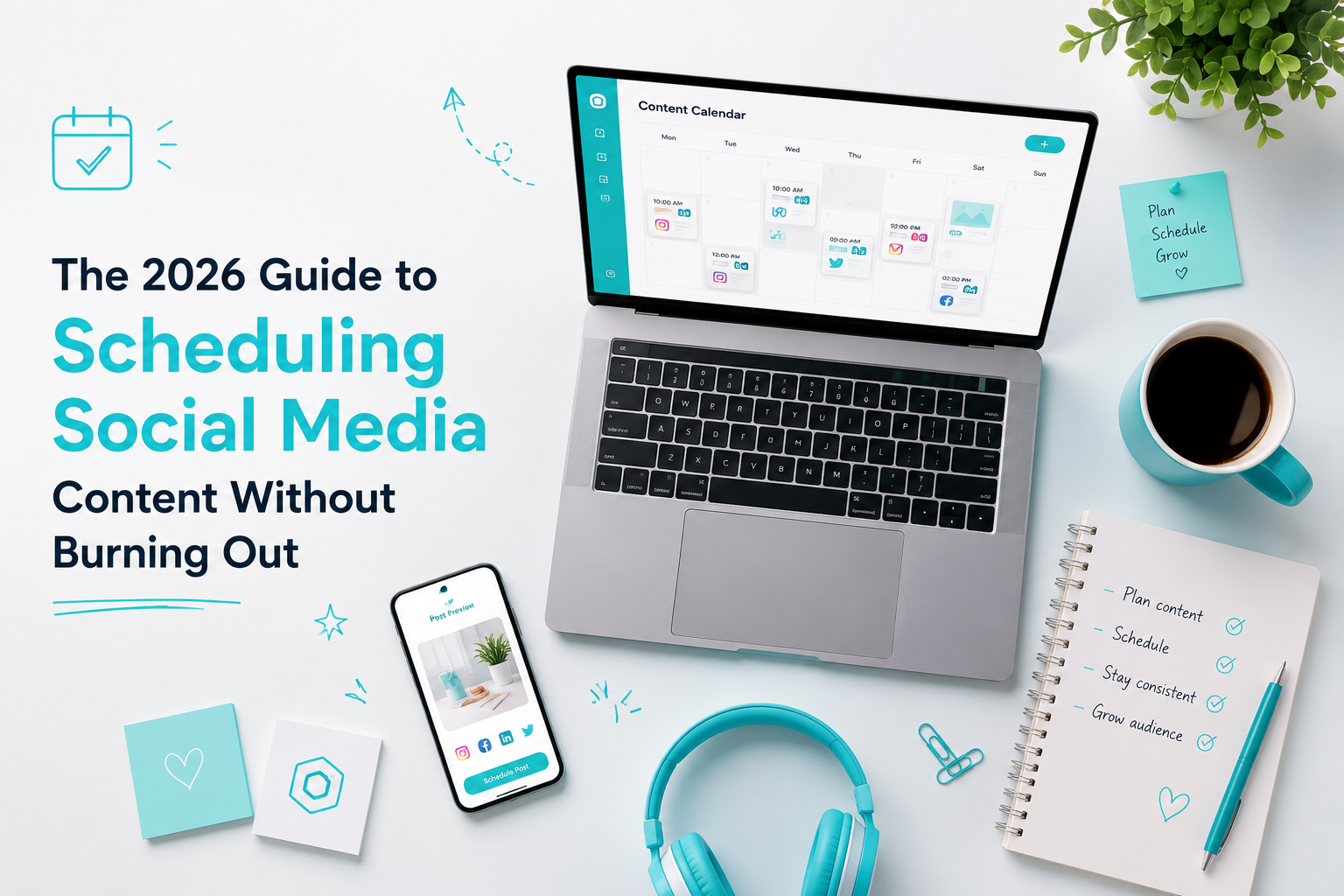
The difference between creators who burn out and those who grow consistently is simple: how they plan and schedule their social media content all together instead of posting randomly.
Why inconsistency is silently killing your reach and the exact social media scheduling framework top creators use to stay consistent, grow their audience, and still have a life.
It started, like most burnout stories do, with the best of intentions.
Her name was Nadia. She ran a small skincare brand from her apartment handmade products, a loyal customer base of about 400 people, and a dream of turning her side hustle into something real. She’d heard a hundred times that “consistency is the key to social media growth.” So she committed. Every single day. Instagram. TikTok. Facebook. She filmed, edited, wrote captions, researched hashtags, posted, replied to comments, checked analytics, and then started the whole cycle again the next morning before her coffee had even cooled.
For six weeks, she posted every single day. Her follower count nudged upward. But something else happened too something she hadn’t expected. She started dreading her phone. The sound of a notification made her stomach drop. She’d open Instagram not with excitement, but with a kind of quiet dread another thing to respond to, another idea she needed to produce, another algorithm she needed to please.
By week seven, she posted nothing for four days. And that’s when the real damage happened.
Table of Contents
The Silent Killer: Inconsistency
Here’s the thing nobody tells you when they hand out social media content advice: it’s not the absence of posting that kills your reach. It’s the pattern of showing up, then disappearing.
Nadia didn’t stop growing because she ran out of ideas. She stopped growing because the burnout that came from an unsustainable workflow caused the inconsistency that damaged her reach. It’s a vicious cycle. And millions of creators and small business owners are trapped inside it right now.
“The algorithm doesn’t punish you for taking breaks. It punishes you for disappearing without warning and then expecting your audience to be waiting when you come back.”
The solution isn’t to post more. It’s to build a system that posts for you — consistently — even when you’re exhausted, uninspired, or simply busy running your actual business.
Why “Just Post Every Day” Is Terrible Advice

The influencer who tells you to “just stay consistent” and post every day at 9am is almost certainly one of two things: someone with a full-time social media content team behind them, or someone on the edge of their own burnout who hasn’t admitted it yet.
The truth is, the human brain is not built for the creative output that daily social media demands. Writing a caption, choosing an image, thinking about the hook, considering the call to action, adapting the format for each platform, researching hashtags, and publishing at the optimal time — that’s not a five-minute task. For most people, done properly, it takes 45 minutes to an hour per post. If you’re managing three platforms, that’s potentially three hours of creative work every single day, on top of everything else your business requires from you.
No wonder people burn out.
73%
of small business owners say managing social media content is the task
they find most exhausting above invoicing, emails, and customer service.
The creators who seem effortlessly consistent , the ones who show up in your feed every Tuesday and Thursday like clockwork, whose social media content always feels fresh and on-brand – they’re not working harder than you. They’ve simply built a smarter system. And that system has three pillars: batching, scheduling, and automating.
The Framework: Batch. Schedule. Breathe.
This is the exact three-part framework that top creators in 2025 are using to maintain a daily presence without living on their phones. It’s not complicated. But it requires a shift in how you think about social media content creation from a daily chore to a weekly ritual.
The Batch · Schedule · Breathe Framework
Batch Create – One Session, One Week of social media Content
Set aside 2–3 hours on the same day each week. This is your content creation block. Write all your captions, choose your images or video clips, and draft everything for the entire week in one focused session. No distractions. No phone calls. Just creation.
Schedule Everything at Once
The moment you’ve finished creating, schedule every single post across every platform for the entire week. Use a scheduling tool that lets you see your content calendar visually, adjust timing per platform, and queue everything with one click. Sunday afternoon becomes your entire week’s social presence.
Breathe -Then Engage
With your posting handled, your only daily social media task is engagement: spend 15 minutes replying to comments, responding to DMs, and interacting with others in your niche. That’s it. The content machine runs without you. You show up as a human, not a content factory.
This framework completely changes your relationship with social media. Instead of waking up every morning and asking “what do I post today?” with all the anxiety that question carries – you wake up knowing it’s already done. Your posts are going out. Your audience is seeing you. And you didn’t have to think about it at 7am.
The Missing Piece: Posting at the Right Time
Batching and social media scheduling solve the consistency problem. But there’s a second problem that most creators ignore entirely: they’re posting at the wrong times.
It doesn’t matter how good your social media content is if it goes live at 2pm on a Tuesday when your audience is in back-to-back meetings. The best-performing posts don’t just have great content they hit the feed exactly when their specific audience is most active and most likely to engage.
The platforms themselves have this data. So do the best social media scheduling tools. In 2025, you should never be manually guessing when to post. Your tool should be analyzing your historical engagement data and telling you: “Your audience is most active on Instagram at 7:30am and 8:00pm. Here’s when to schedule this week’s posts.”
💡 Pro Insight
Posting at the wrong time can reduce your post’s organic reach by up to 60% — even if the content itself is excellent. Timing is not a nice-to-have. In 2025, it’s as important as the social media content itself.
When you combine batching with smart, data-driven social media scheduling, something remarkable happens: your consistency improves, your timing improves, your reach grows — and your effort actually decreases. You’re working smarter, not harder. The algorithm rewards you for being predictable. Your audience trusts you because you show up. And your business grows because you didn’t burn yourself out chasing a content treadmill.
What Nadia Did Next
After her four-day silence, Nadia didn’t just start posting again. She stopped and rebuilt her whole approach.
She started batch-creating every Sunday afternoon – two hours, headphones in, no interruptions. She wrote captions for the entire week, pulled together her images, and scheduled everything across Instagram, Facebook, and TikTok before Sunday dinner. She stopped thinking about social media as a daily obligation and started treating it as a weekly ritual.
She also stopped trying to post every single day. Three times a week, at consistent, data-driven times, with content she actually felt proud of. The quantity dropped. But the quality and the consistency went up dramatically.
Within six weeks of switching to this system, her average post reach had increased by 34%. Her follower growth was more than double what it had been during her exhausting daily-posting phase. And she’d reclaimed her mornings.
“I used to dread opening Instagram,” she told us. “Now I barely think about it during the week. Everything’s already scheduled. I just pop in to reply to comments and I’m done. It changed everything.”
The 2026 Consistency Checklist: Social Media content

Before we wrap, here’s the practical checklist to take this framework and actually implement it this week:
Your Weekly Consistency Checklist
Sunday (or your chosen batch day): Block 2 hours. Write all captions. Select images and video clips. Schedule everything across platforms for the week ahead. Set posting times based on your analytics data — not gut instinct.
Monday–Friday: Spend 10–15 minutes each morning on engagement only. Reply to comments. Respond to DMs. Interact with 5–10 accounts in your niche. That’s your entire social media task for the day.
End of week: Check your analytics. What performed best? Use those insights to shape next Sunday’s content batch. Repeat.
Never: Open a social media app first thing in the morning with no plan. Never post “on the fly” out of guilt. Never sacrifice your consistency for the myth of spontaneity.
Consistency is a System Problem, Not a Willpower Problem

If you’ve struggled to stay consistent on social media content , it’s not because you’re lazy, undisciplined, or “not cut out” for content creation. It’s because you’ve been approaching a systems problem as a motivation problem trying to summon fresh willpower every single morning instead of building a structure that makes consistent posting the path of least resistance.
The creators who seem effortless aren’t more talented. They’re better organized. They’ve removed the daily decision-making. They batch, they schedule, they let the system run and then they show up as human beings to have real conversations with their audience.
That’s the secret. Not hustle. Systems.
Nadia’s skincare brand crossed 5,000 followers last month. She posts three times a week. She spends two focused hours on social media content every Sunday. And she hasn’t felt that quiet phone-dread in months.
You don’t have to burn out to grow. You just have to build the right system and let it work. If you want a done-for-you system or managed approach, you can also check this:
Social Media Manager