

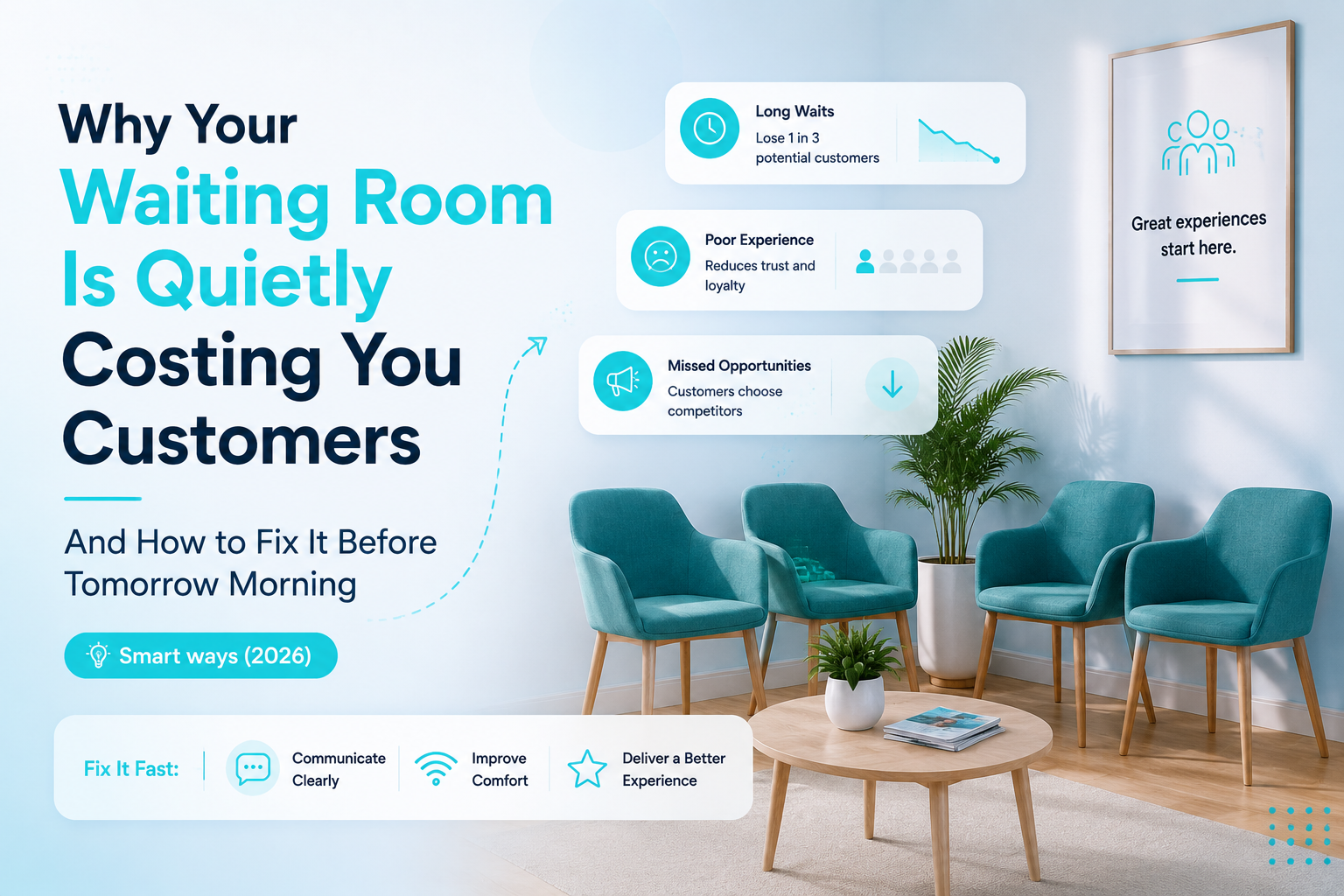
Why Your Waiting Room Is Quietly Costing You Customers And How to Fix It Before Tomorrow Morning- Smart ways (2026)
May 12, 2026
Your Google rating isn’t just a vanity metric it’s the single biggest factor in whether a first-time customer walks through your door or goes to your competitor instead. Here’s everything you need to know.
93%
of customers read reviews before visiting a local business
4.2★
minimum rating customers trust for first-time purchases
$0
cost of a 5-star review earned organically
Imagine two coffee shops side by side. Identical menus. Similar prices. Same neighborhood. One has 47 Google reviews averaging 3.8 stars. The other has 312 reviews averaging 4.7 stars. A new customer walks down the street, pulls out their phone, and types “coffee near me.” Which shop do they walk into?
The answer is obvious and it explains why online reputation management has quietly become one of the most powerful and least understood growth levers available to small business owners today.
This is not about vanity. It’s not about chasing stars for the sake of optics. It’s about the fundamental reality that in 2025, your online reputation is your storefront often seen before your actual front door, your website, or your social media profiles.
Table of Contents
What Is Online Reputation Management – Really?

Most business owners hear “reputation management” and think one of two things: crisis PR for big corporations, or shady services promising to “remove bad reviews.” Neither is accurate when applied to the day-to-day reality of a small or medium-sized business.
Real online reputation management (ORM) for small businesses is simply the ongoing practice of understanding, influencing, and improving how your business appears to potential customers online. It covers three interconnected areas:
- Review generation – actively encouraging satisfied customers to share their experience publicly on platforms like Google, Facebook, Trustpilot, or Yelp.
- Review monitoring – keeping track of what people are saying across all relevant platforms, so you’re never blindsided by feedback you didn’t know existed.
- Review response and recovery – engaging with both positive and negative reviews in a way that demonstrates professionalism, builds trust, and sometimes converts a disappointed customer into a loyal one.
Most businesses fail at all three not because they don’t care, but because they have no system. They rely on customers volunteering reviews unprompted (almost no one does), they check Google occasionally but inconsistently, and they either ignore negative reviews or respond defensively.
The good news? Fixing all three is far simpler than most people assume. And the returns are disproportionately large.
The Numbers That Should Change Your Mind
If you’ve ever dismissed online reputation as a “nice to have” rather than a core business priority, the data will make you reconsider. The relationship between review volume, review quality, and actual revenue is not subtle it’s dramatic.
And perhaps most striking of all: a single negative review can cost a business up to 30 potential customers, according to studies on consumer trust behavior. Meanwhile, responding to that negative review promptly and professionally can recover the majority of that trust.
“Your reputation is not what you say about yourself. It’s what Google shows when someone searches your name and whether it makes them click or scroll past.”
Why Most Businesses Are Losing the Reputation Race

Here is the uncomfortable truth: most small business owners know that reviews matter. They’ve read the articles. They’ve heard the advice. And yet, the vast majority of businesses have a review profile that doesn’t reflect the actual quality of their product or service.
Why? Because there is a massive, structural gap between the experience customers have and the likelihood that they’ll document it publicly.
The Silent Majority Problem
Think about your own behavior as a customer. You’ve had hundreds of good experiences at restaurants, shops, and services over the past year. How many times did you leave a review? Probably a handful and usually only when something was exceptional or something went badly wrong.
This isn’t unusual. Research consistently shows that only about 1 in 10 satisfied customers leaves a review without being asked. But when customers are asked at the right moment, in the right way, that conversion rate jumps dramatically sometimes to 1 in 3.
The businesses winning at reputation management are not getting lucky. They’re not serving better coffee than you or fixing cars faster. They are simply asking, consistently, systematically, and at the right time.
The Recency Decay Problem
Reviews have a shelf life in the minds of consumers. A business with 200 reviews, the most recent of which is from 18 months ago, triggers suspicion. Has quality dropped? Did they shut down? Are these reviews even real?
Google’s algorithm also favors recency. Fresh reviews from the past 90 days carry significantly more weight in local search rankings than older ones. This means a business that collected a burst of reviews three years ago and then stopped is actively losing ground to a competitor who is generating reviews steadily every month — even if that competitor has fewer total reviews.
💡 Key Insight
The goal is not to collect 500 reviews and stop. The goal is a steady, ongoing flow — at least 4–8 new reviews per month for most local businesses. This signals to both Google and to potential customers that your business is active, trusted, and consistently delivering good experiences.
The Negative Review Blindspot
Here’s a scenario that plays out thousands of times every day: a customer has a bad experience. Rather than telling the business owner giving them a chance to fix it , they go straight to Google and leave a 1-star review. The business owner doesn’t see it for two weeks. By then, three other potential customers have read it and gone elsewhere.
This is not an edge case. It is the default behavior of dissatisfied customers. They don’t want confrontation. They want a way to express their frustration and warn others. And in the absence of any other channel, they use Google.
The fix is elegantly simple: give unhappy customers a private channel before they reach for a public one. When a customer is asked for feedback immediately after their experience, a portion of those who would have posted a negative public review will instead share their concerns privately — giving you the chance to acknowledge, apologize, and resolve the issue before it becomes permanent digital damage.
The SEO Connection: Reviews Are Free Local Search Marketing
One dimension of online reputation that many business owners completely overlook is the direct relationship between your review profile and your visibility in Google search results.
Google’s local search algorithm — the engine that powers the “map pack” results you see at the top when you search for “dentist near me” or “pizza delivery” — takes review signals very seriously. Specifically, it looks at:
- Review quantity: Total number of reviews signals to Google that your business is established and trusted.
- Review velocity: How recently and how frequently reviews are being added. A steady drip beats a historical spike.
- Average rating: Higher-rated businesses rank better in local results, all else being equal.
- Review diversity: Reviews across multiple platforms (not just Google) signal authentic popularity.
- Review keywords: When customers naturally mention your services (“amazing burgers,” “quick tyre change”) in reviews, those keywords reinforce your relevance for related searches.
What does this mean practically? A business that actively manages its reputation and generates a consistent flow of positive reviews is effectively running a free, compounding SEO campaign. Every new review adds to a growing body of social proof that both humans and algorithms use to determine trustworthiness.
Businesses that have invested in reputation management report appearing more frequently in the coveted “local pack” results the three businesses shown prominently at the top of local search pages and seeing measurable increases in website traffic, phone calls, and direction requests directly attributable to improved review profiles.
The Right Way to Respond to Negative Reviews
No business is perfect. At some point, you will receive a negative review — perhaps deserved, perhaps not. How you respond matters enormously, both for the customer who left the review and for every future customer who reads your response.
Studies on consumer trust show that 45% of consumers say they are more likely to visit a business that responds to negative reviews. That’s nearly half your potential customers watching not just what went wrong, but how you handle it.
The Framework for a Perfect Response
The most effective responses to negative reviews follow a simple four-part structure:
- Acknowledge without becoming defensive. Use the customer’s name if it’s visible. Thank them for the feedback — genuinely. This immediately signals to readers that you take concerns seriously.
- Take ownership. Even if the review feels unfair, avoid explaining why the customer is wrong. Instead, acknowledge their experience: “We’re sorry your visit didn’t meet expectations.” This is not an admission of guilt — it’s a demonstration of character.
- Move the conversation offline. Invite the reviewer to contact you directly — provide an email or phone number. This shows you’re committed to resolution and takes the back-and-forth out of public view.
- Keep it short. Lengthy justifications read as defensiveness. Two to four sentences is almost always the right length for a response to a negative review.
What you should never do: ignore the review, respond with sarcasm or hostility, argue about the facts publicly, or paste the same generic response to every complaint. Each of these behaviors signals to prospective customers that you handle problems poorly — which is exactly the opposite impression you want to leave.
“A well-handled negative review can actually be more persuasive than a positive one — it shows real people that you’re a business worth trusting when things go wrong.”— Customer Trust Research, BrightLocal 2024
Manual vs. Automated Reputation Management: An Honest Comparison
Let’s be direct about the practical reality of managing reviews manually versus using an automated platform. Both approaches can work — but they are not equally efficient, and the gap becomes more significant as your business grows.
| What You’re Managing | Manual Approach | Automated Platform (ownerhive) |
|---|---|---|
| Sending review requests | Depends on staff remembering | Sent automatically at the right moment |
| Review request timing | Often too late or never | Optimized for peak conversion |
| Handling unhappy customers | No filter public by default | Private routing before going public |
| Monitoring across platforms | Hours per week, multiple logins | One dashboard, instant alerts |
| Consistency | Drops during busy periods | 100% consistent regardless of workload |
| Reporting & insight | Spreadsheets, manual counting | Automatic analytics and trends |
| Time investment per week | 4–8 hours | Under 30 minutes |
This comparison isn’t meant to dismiss the manual approach some very small businesses do manage their reputation effectively without dedicated software. But for any business interacting with more than 20–30 customers per week, manual management almost always breaks down under the weight of other priorities. Reviews stop being requested. Platforms go unmonitored. A bad review sits unresponded to for a month.
Automation doesn’t replace judgment , you still decide what your review request says, how you respond to feedback, and which platforms matter most. It simply ensures that the system actually runs, every day, regardless of how busy things get.
Building a Long-Term Reputation Strategy
Online reputation management is not a campaign with a start and end date. It’s an ongoing operational habit — more like brushing your teeth than running a marketing sprint. The businesses that win over the long term are those that embed reputation management into their daily operations, not those who chase it reactively after a bad review appears.
Phase 1: Foundation (Month 1–2)
Claim and fully complete your profiles on all relevant platforms — Google Business Profile, Facebook, Yelp, Trustpilot, and any industry-specific platforms that matter to your sector. A complete profile (photos, hours, description, services) performs significantly better in search than a sparse one. Set up a system — manual or automated — to begin requesting reviews from every customer interaction.
Phase 2: Momentum (Month 3–6)
Focus on volume and recency. Aim for a steady drip of new reviews every week. Begin monitoring response times and make sure every review — positive or negative — receives a response within 48 hours. Track your average rating monthly and identify any patterns in negative feedback that suggest operational improvements.
Phase 3: Optimization (Month 6+)
At this stage, reputation management starts to become genuinely strategic. Use the data from your reviews to inform product decisions, training priorities, and marketing messages. Your happiest customers, and the words they use to describe what they love, are a direct window into your most compelling value proposition. Many businesses discover that their most effective marketing copy comes directly from their five-star reviews.
🚀 Quick Win Checklist
Start this week:
(1) Claim and complete your Google Business Profile.
(2) Respond to every existing review , even old ones
(3) Identify your last 10 happy customers and personally ask them to share a review.
4) Set up a simple process to ask every future customer.
These four steps alone will move the needle faster than almost anything else you can do in an afternoon.
The True Cost of Ignoring Your Reputation

We’ve talked extensively about what you gain from managing your reputation well. It’s equally important to understand what you lose by ignoring it because the cost is real, measurable, and compounding.
A business with a 3.5-star average on Google, in a market where competitors average 4.5 stars, is not competing on equal terms. It is starting every day at a structural disadvantage. Every person who searches for your category and sees the comparison makes a rational decision — and it’s not in your favor.
And unlike most business problems, a reputation deficit is self-reinforcing. Fewer new customers mean fewer opportunities for positive reviews. Fewer reviews mean lower rankings. Lower rankings mean even fewer new customers. Left unaddressed, a weak review profile doesn’t stay weak — it gets relatively weaker as competitors improve and the algorithm rewards freshness.
The inverse is equally true. A strong review profile compounds in your favor. More reviews improve your ranking, which brings more traffic, which creates more satisfied customers, which generates more reviews. The businesses that start early and build consistently create a moat that becomes increasingly difficult for competitors to close.
The question isn’t whether your online reputation matters. The evidence on that is conclusive. The question is whether you’re going to manage it intentionally — or leave it to chance, to unhappy customers with time on their hands, and to competitors who are not leaving it to chance.
Where ownerhive Review Booster Fits In
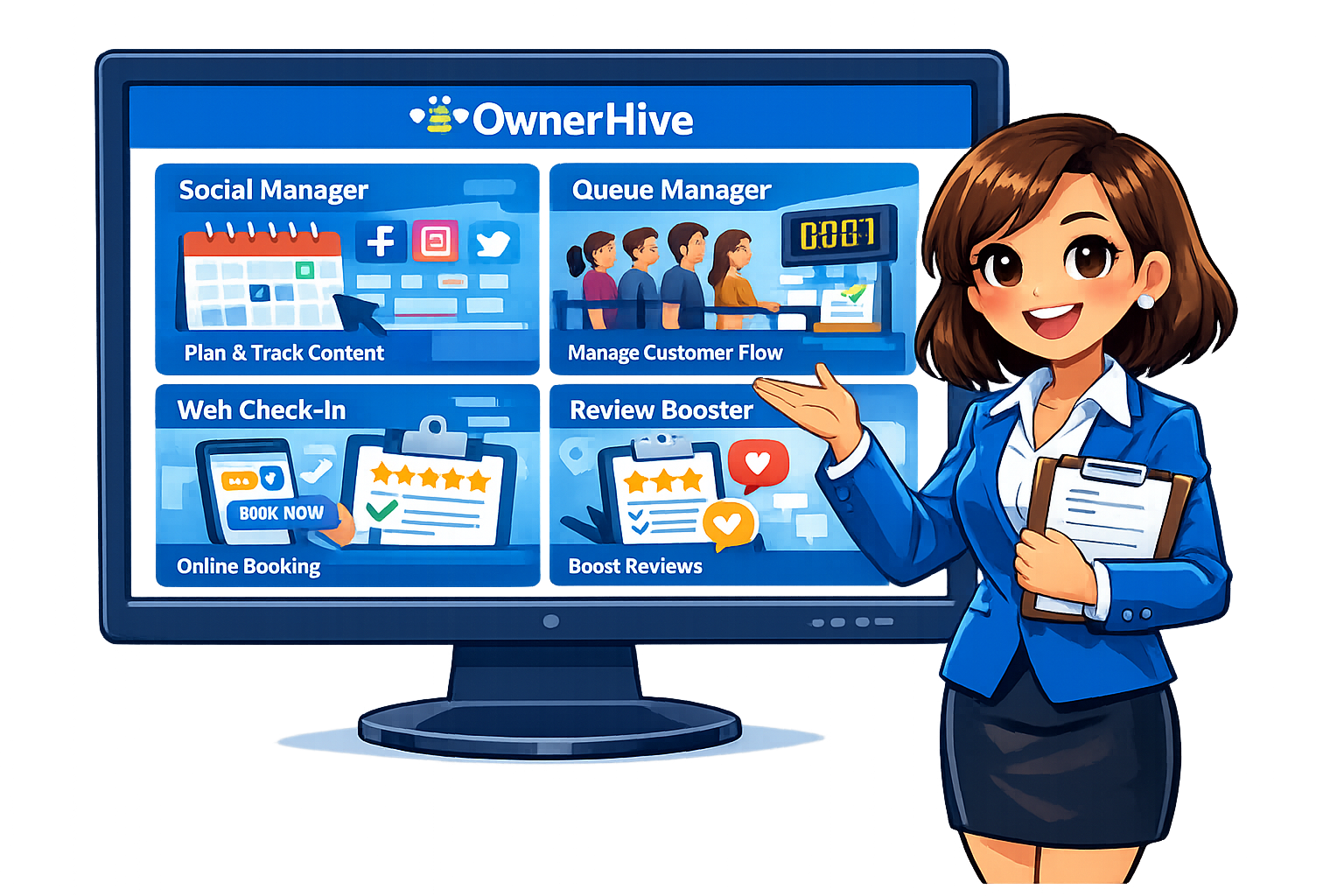
Everything described in this article the consistent review requests, the feedback filtering to protect your public profile, the multi-platform monitoring, the automated timing – is exactly what ownerhive’s Review Booster was built to handle.
The premise is straightforward: most business owners know they should be managing their reputation more actively, but the manual effort is too high to sustain. Review Booster removes that barrier by automating the entire cycle — from sending review requests via SMS, email, or WhatsApp at the optimal post-interaction moment, to routing dissatisfied customers to a private feedback form before they reach Google.
Businesses using Review Booster typically see their review volume increase by 3× within the first 60 days, their average rating climb toward 4.8+ as the filtering system intercepts the majority of low-score submissions, and 5+ hours per week returned to the team from the elimination of manual review monitoring.
This isn’t marketing copy. These are operational outcomes that change the trajectory of a business’s online presence and by extension, its revenue.
If you’ve read this far, you already understand why your reputation matters. The only remaining question is what you’re going to do about it today.