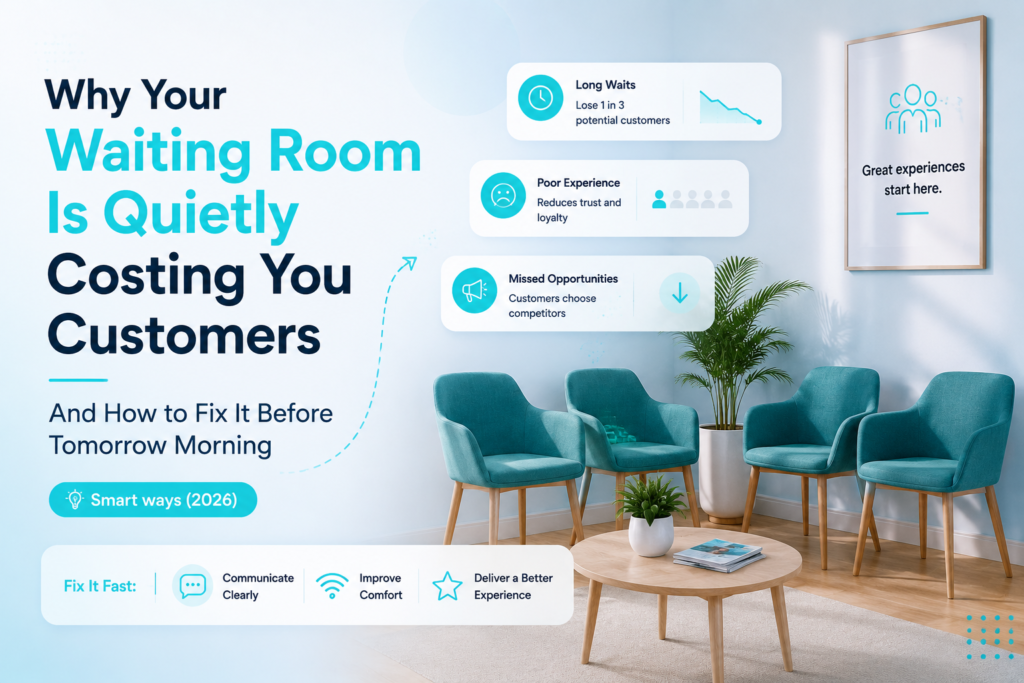

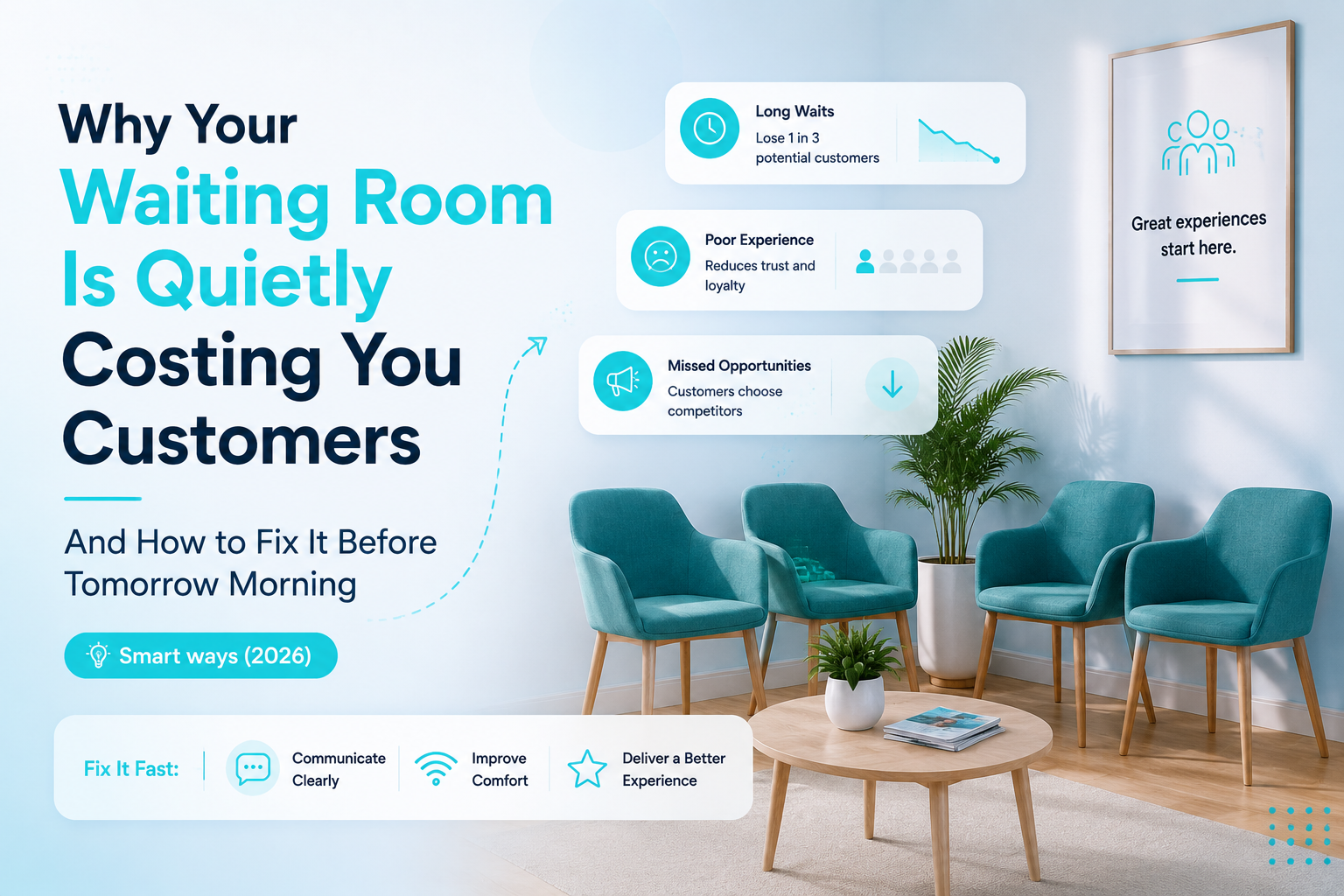
Why Your Waiting Room Is Quietly Costing You Customers And How to Fix It Before Tomorrow Morning- Smart ways (2026)
May 12, 2026
The 2026 Guide to Scheduling Social Media Content Without Burning Out
May 12, 2026
Picture this. It’s a Tuesday afternoon and a potential new customer , let’s call her Priya – has finally decided to visit your walk-in clinic after weeks of putting it off.
She parks, walks in, and immediately sees a waiting room with six people in it and a front desk that looks overwhelmed. Nobody acknowledges her. There’s no number system, no estimated wait time on the wall, and no one can tell her how long she’ll be waiting.
Priya waits four minutes. Then she leaves. Not because your clinic provides bad care. Not because she found a better option. She left because of uncertainty , the most underestimated force in customer behavior.
She had no idea if she’d be waiting 10 minutes or 90 minutes, and that not-knowing was more uncomfortable than the inconvenience of going home and trying again another day.She never comes back. And she never tells you why.
This scene – with different names, different businesses, different waiting rooms plays out thousands of times every single day. And the businesses losing those customers almost never know it’s happening, because customers like Priya don’t complain. They just leave. Quietly, permanently, and invisibly.
Table of Contents
The Real Enemy Isn’t Waiting – It’s Not Knowing
Here’s something counterintuitive that decades of customer psychology research have confirmed: people do not hate waiting as much as they hate not knowing how long they will wait.
This is not a small distinction. It is the entire game of.

In a landmark study, researchers asked two groups of people to wait in line. One group was told “you’ll wait about 15 minutes.”
The other group was simply told to wait, with no time estimate. Objective wait times were identical for both groups. But the group with the estimate rated their experience significantly more positively even when the actual wait exceeded the estimate slightly.
What they were measuring wasn’t time. It was control. When people know what to expect, they can plan. They can decide.
They can mentally accept the wait and move on with their thoughts. When they don’t know, they remain in a state of anxious suspense , constantly checking the time, reassessing whether to stay, unable to relax or do anything productive.
73%
of customers say a transparent wait time improves their experience — even if the wait itself doesn’t change
Simply knowing how long the wait is and receiving a heads-up before it’s their turn transforms a frustrating experience into an acceptable one. The wait didn’t get shorter. The dread did.
This is why virtual queue management is not just an operational upgrade. It is, at its core, an act of respect for your customers’ time and their mental state.
It says: “we see you, we know you’re here, and we want you to use your time as well as possible while we get ready for you.”
What Walk-Away Customers Are Really Costing You
Before we talk about solutions, we need to sit honestly with the scale of the problem. Because most businesses that lack a queue system genuinely don’t know how many customers they’re losing and when they find out, the number is always larger than expected.
Real-World Scenario -Walk-In Health Clinic
A walk-in clinic in a mid-sized city was seeing consistent patient volumes but couldn’t understand why their revenue had plateaued despite no apparent drop in service quality.
When they installed a virtual queue system, they discovered something startling: their front-door camera data showed that roughly 1 in 5 people who physically entered the clinic left without registering – usually within the first 3 minutes.
That’s a 20% walk-away rate. At an average consultation value of $85, with approximately 60 walk-ins per day, the clinic was quietly losing over $1,000 in potential revenue every single day , not to competition, not to bad reviews,
but simply because patients couldn’t see an estimated wait time and made the decision to leave rather than risk an unknown wait.
Within 30 days of deploying Queue Manager, their walk-away rate dropped to under 6%. The clinic’s monthly revenue increased by nearly $18,000 without a single change to their service, their staff, or their pricing.
The math is not unique to clinics. Wherever people have to wait without information — law firm reception areas, government service offices, repair shops, busy retail counters , the walk-away rate follows a predictable pattern driven by uncertainty. Solve the uncertainty, and you solve the walk-aways.
40%
average reduction in customer walk-aways reported by businesses after deploying a virtual queue systemAcross industries from healthcare to hospitality to professional services , removing the uncertainty of waiting consistently converts a significant portion of would-be walk-aways into completed transactions and loyal repeat customers.
How Virtual Queue Management Actually Works – No App Required

When most people hear “queue management system,” they imagine expensive hardware, tablet kiosks bolted to the wall, and a complicated setup that requires a dedicated IT person. This was true a decade ago. It is not true today.
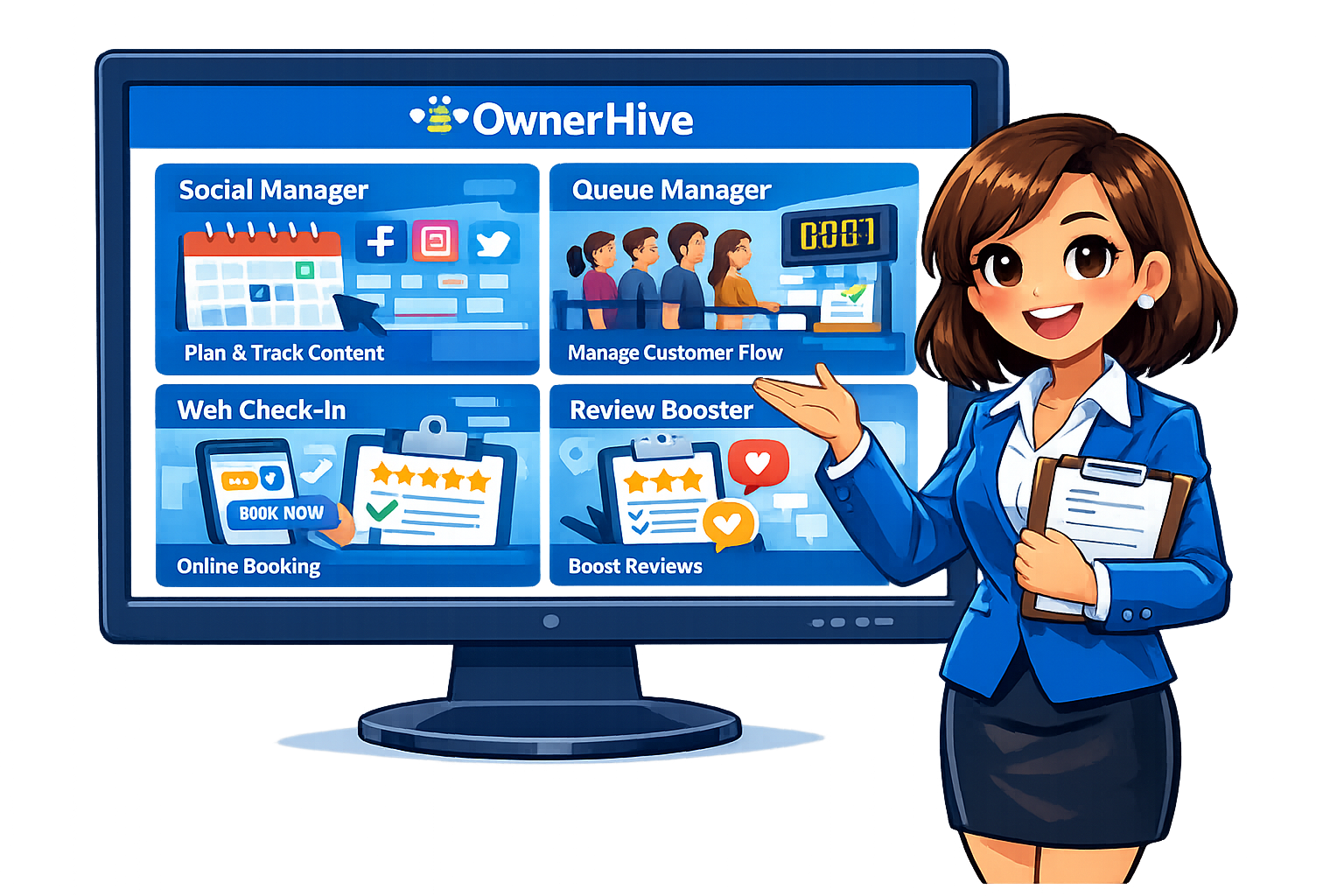
Modern virtual queue systems like ownerhive’s Queue Manager work through a mechanism that every single one of your customers already has in their pocket and knows how to use: SMS text messaging.
Here is the entire customer experience, from arrival to service:
Customer arrives and sees the sign
A simple placard at your entrance reads: “Skip the wait , text JOIN to 07XXX XXXXXX to hold your place in line.” No app. No account. No QR code confusion. If they can send a text, they’re in.
Instant confirmation with live link
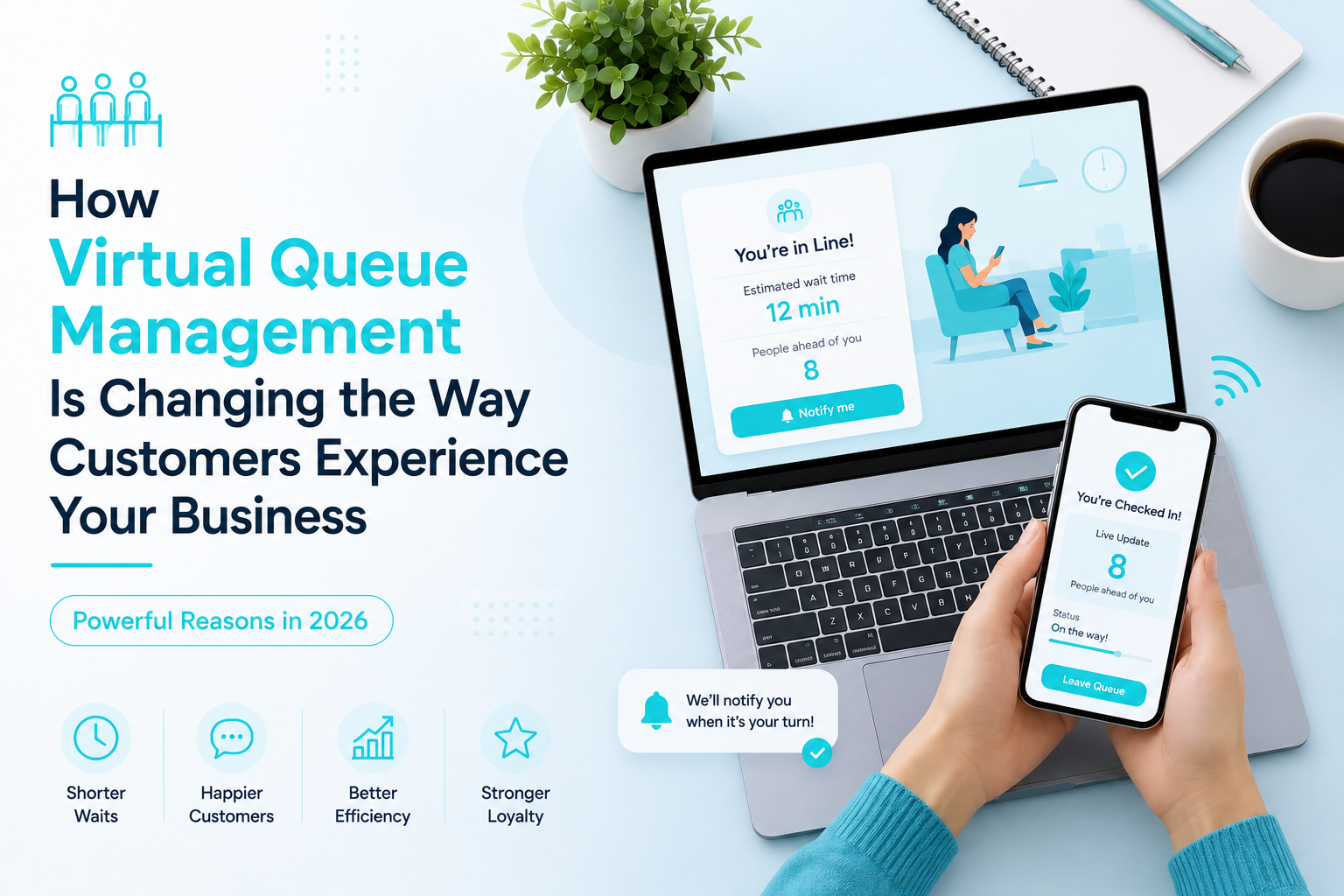
Within seconds, they receive a text back: “You’re #4 in the queue. Estimated wait: ~18 minutes. Track your position live: [link].” The link opens a branded page no login needed showing the live queue status that refreshes automatically.
Proximity alert -“You’re almost up”
When they reach position #2, they automatically receive a text: “You’re almost up please make your way back now.” They arrive calm, on time, and without having wasted a second sitting in a chair doing nothing.
Served and delighted
They’re called in feeling respected, relaxed, and ready. Not frazzled from waiting. Not resentful about wasted time. The interaction starts on a positive emotional footing , which directly influences how they rate the entire experience afterward.
The entire system takes less than 10 minutes to set up. There is no hardware to install. No app for your staff to learn. No special training required. The text number is dedicated to your business, and the whole experience from the confirmation message to the live status page to the proximity alert can be fully branded with your business name and colours.
The Industries Transformed Most Dramatically by Virtual Queuing
Virtual queue management improves the customer experience in virtually any business where waiting occurs. But there are specific sectors where the impact is so significant it effectively changes the competitive landscape:
- Walk-In Clinics & GP Surgeries
- Law Firms & Legal Aid
- Auto Repair & Device Repair
- Salons & Beauty Services
- Retail & Click-and-Collect
↓ 68% reduction in no-shows reported
Patients who know their position don’t lose their place and return on time. Waiting rooms become calmer. Staff spend less time managing impatient queues and more time on care.
↑ 35% increase in first-appointment completion
Clients who would previously abandon after a long wait now stay engaged through the queue. The virtual system projects professionalism before the meeting even begins.
↑ Significantly higher review scores
Customers drop off and return when ready instead of sitting in uncomfortable waiting areas for unknown periods. The improvement in mood translates directly into better reviews.
↑ 28% increase in completed bookings
Walk-in customers who would previously leave if all chairs are full now join the virtual queue and return converting a lost opportunity into a completed service and a new regular client.
↑ Higher average basket value
Customers who wait virtually and arrive relaxed , tend to browse longer and spend more. Stress-free waiting removes the urgency to grab and go, leading to larger transaction values.
The Hidden Benefit Nobody Talks About: Your Staff’s Wellbeing
Most discussions about queue management focus entirely on the customer. Understandably — the customer experience metrics are dramatic and the revenue impact is immediate. But there’s an equally important benefit that business owners often only discover after deployment: the transformation in their team’s working environment.
When customers are waiting with no information, they become impatient. That impatience gets directed at the nearest available person — usually the receptionist, the front desk staff, or the first team member a customer can reach. “How much longer?” “I’ve been waiting 20 minutes.” “Why is this taking so long?” These interactions are not just annoying — they are genuinely draining for the people on the receiving end, and over time they contribute directly to staff burnout, reduced morale, and higher turnover.
“When we put in the queue system, the first thing I noticed wasn’t the numbers — it was that my receptionist stopped going home exhausted. She told me that 80% of the difficult interactions she’d been having were from people frustrated about waiting. That just stopped.”— Walk-in clinic owner, 6 months after deploying ownerhive Queue Manager
A virtual queue system doesn’t just improve the customer’s experience of waiting — it removes the pressure that an unmanaged queue creates throughout your entire operation. Your staff work with people who arrive calmer, more prepared, and more positively disposed toward the interaction. That is a measurable improvement in working conditions that affects recruitment, retention, and the quality of service your team is able to deliver.
Queue Data Is Business Intelligence -If You Know How to Read It

One of the most underappreciated aspects of a modern virtual queue system is the data it generates. Every customer who joins the queue, every wait time, every no-show, every peak period — all of this is captured automatically and made available in your dashboard.
This data is genuinely transformative for operational decision-making:
- ✓Peak hour mapping — See precisely when your busiest periods are, broken down by day of week and time of day. Stop guessing about staffing — let your own queue data tell you exactly when you need more people on the floor.
- ✓Average service duration — Know how long each type of interaction actually takes on average. Use this to set more accurate wait time estimates, which in turn increases customer satisfaction and reduces early departures.
- ✓Drop-off tracking — Identify the queue positions and time windows where customers most often abandon. If people consistently leave when they’ve been waiting more than 25 minutes, that’s a signal about capacity, not just patience.
- ✓Location-level comparison — For multi-branch businesses, compare queue performance across sites. Identify which locations are managing flow efficiently and which need operational adjustments.
- ✓Monthly trend lines — Track whether your wait times are improving or worsening over time as your business grows. Catch capacity problems before they start affecting your review score.
This is the kind of intelligence that used to require expensive consultants or complex CCTV analysis systems. With a virtual queue platform, it’s simply part of the product — generated automatically, presented clearly, and updated in real time.
💡 Pro Insight
One of the most valuable uses of queue data is in reviews management. Businesses that correlate their queue wait times with their Google review scores consistently find a direct relationship: weeks with longer average waits produce lower review scores, even when the quality of service itself doesn’t change.
This means your queue data is also an early warning system for your online reputation giving you a chance to address capacity issues before they start appearing in public feedback.
Why “We’ll Try It Later” Is the Most Expensive Decision You’re Making
Here’s the reality that every business owner reading this needs to sit with for a moment: your competitors are not waiting for later.
The adoption of virtual queue systems across service industries has accelerated dramatically since 2022, driven by a combination of post-pandemic expectations around contactless service, the explosion of affordable SMS-based platforms, and the straightforward realization that unmanaged waiting is a solved problem.
The businesses that deployed early are already operating with lower walk-away rates, higher review scores, and more data-driven staffing decisions than their competitors.
Every week that passes without a queue system is another week of silent customer walk-aways that you’ll never measure. Another week of front desk staff managing impatient customers instead of serving happy ones. Another week of lost revenue that doesn’t show up in any report because the customers who left never registered in the first place.
The setup takes under 10 minutes. The cost is a fraction of the revenue you’re losing to walk-aways. And the effect on your customers’ first impression of your business — the sense that you respect their time enough to manage it thoughtfully — is felt immediately, in every interaction, from day one.
Priya didn’t leave because your service was bad. She left because she couldn’t see the future. Give your customers a window into what’s coming, and the overwhelming majority of them will stay. They will wait. They will be served. And they will remember the experience as the kind of business that treated them like their time mattered.
That’s the competitive advantage that virtual queue management quietly delivers not just to your metrics, but to the relationship between your business and every single person who walks through your door.